Showing posts with label Working with.... Show all posts

Monday, 5 September 2016

Woking with... colour

What happens when we change the colours of a drawing. Do we still get the same feeling?

These are the real colours.

Any colour you want.

Colours from the same spectrum.
EXPRESSIONISM (Germany, 1905-1933)
Expressionism emerged simultaneously in various cities across Germany as a response to a widespread anxiety about humanity's increasingly discordant relationship with the world and accompanying lost feelings of authenticity and spirituality.
  1. The arrival of Expressionism announced new standards in the creation and judgment of art. Art was now meant to come forth from within the artist, rather than from a depiction of the external visual world, and the standard for assessing the quality of a work of art became the character of the artist's feelings rather than an analysis of the composition.
  2. Expressionist artists often employed swirling, swaying, and exaggeratedly executed brushstrokes in the depiction of their subjects. These techniques were meant to convey the turgid emotional state of the artist reacting to the anxieties of the modern world.
Drei Pferde, Franz Marc. 1912
Fränzi in front of carved chair, Ernst Ludwig Kirschner. 1910

Tuesday, 24 November 2015

Working with... Squares

 Creating an abstract drawing with squares:
  1. The teacher will write on the whiteboard 10 numbers in cm., for exemple: 9,3,7,2,1,4,5,2,6. These numbers are the square's side size. 
  2. How to draw a square knowing its side.
  3. Each student will draw the square wherever he/she wants. 
  4. Once all the squares are drawn, the student has to decide wich one is going to be on top or beneath the other. The lines that will not be needed will be erased.
  5. Colour the composition.


Wednesday, 7 October 2015

Working with... light and shade II

How different can it be to finish a drawing with a pencil or coloured pencils? The same exercise, but not the same result!!
        1. With a pencil:
Adià Viñau
     2. With coloured pencils:
Maria Rosa
Sandra

Tuesday, 6 October 2015

Working with... Lines II

Creative composition with lines.

  1. Draw parallell lines on a white paper.
  2. Cut out simple shapes.
  3. Glue the drawn paper onto another and then the shapes, but changing its direction.

You will get an abstract artwork 

Sofia Benavides


Friday, 25 September 2015

Working with... Lines I

Onofre C. Martí
Original drawings made with lines
Leandro Marín
Miquel Nebot


Tuesday, 21 January 2014

Working with... Colour Wheel

      A different way of working with the Colour Wheel.  You will not use colours or paint this time, but magazines, scissors and glue.

Go for it!!!!


Monday, 20 January 2014

Beautiful Oops.

Watch the  Beautiful Oops video, by Barney Saltzberg.


What happens when you:
  • torn a paper,
  • spill paint,
  • bent paper,
  • dripp paint,
  • etc.

Monday, 13 January 2014

Symmetry and printing.

Today we are going to work with symmetry and temperas. 

The material we will need is:
  • Temperas
  • Paper
  • Brushes
Important: You can only paint on one side of the paper. If the tempera got dry, paint again on the same spot, never on the stamped one. The interesting effect is to see the difference between one side and the other.

1. You will fold your paper in half, and then draw just the half of an image on it. Before the tempera dries you will fold the paper and press, so the tempera will transfer to the other half of the paper and make a whole image!!!
Pau
Joan P.
Ainoha R.

Wednesday, 28 August 2013

Working with ... Silhouettes.

     Draw 16 different silhouettes inside the grid. Remember, do not draw numbers, letters or symbols.

Carmen O.

Pau G.
I've found in internet a photographer that has worked with silhouettes but the other way around we have done. Have a look...

Working with ... Organic and Geometric Shapes

     For this exercise each student has to choose an Organic and a Geometric Shape. They have to be easy shapes to recognize, because we are going to work with the silhouettes.

Example of Shapes:
  • Organic: fish, tree, flower, apple, person, etc
  • Geometric: key, knife, car, candel, scissors, etc.
Steps:
  1. Draw the silhouettes on a card.
  2. Cut the shapes out.
  3. Get a new white paper.
  4. Use the shapes as a stencil and draw several times the organic shape all over a the paper. It can be half shape on the sides.
  5. Now, do the same with the geometric shape. The interesting part of the composition is to draw one shape over the other.
  6. Re-trace with black ink ( 0'4), and erase the pencil once it is dry.
  7. Colour each piece in a different colour. For the background use a new colour (grey, black,...).

The result will be a colourful composition. Check the examples of other students:


Stencil shapes


Irene R.

Sunday, 14 July 2013

Working with ... Radial symmetry

    
Students have to finish the satined glass following the radial symmetry.


And then, colour the composition once finished drawing and inking it (0'8).
 
Aike Riera


Ting


Damià V.


Saturday, 13 July 2013

Working with ... Symbols.

Each student will get a copy with symbols on it, and has to design a face with any of them.

  1. The symbol size and the direction can be changed.
  2. The symbol itself has to remain the same, for example two brakets can not be closed to become a square. 
  3. They have to draw at least 4 sketches before doing the final work.
  4. Is going to be a black and white edrawing.
Examples of my students' work


Paula T.
Marc R.
Alicia M.
Sketches


Friday, 12 July 2013

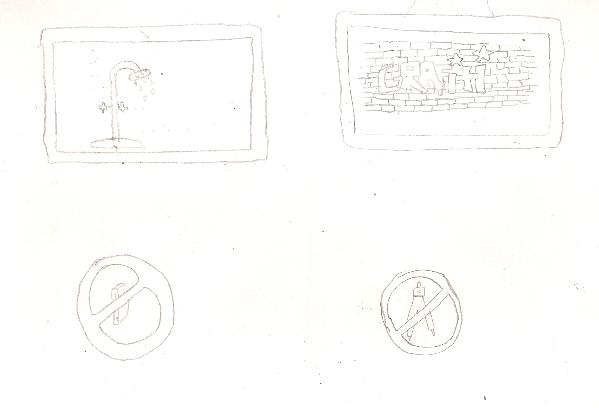
Working with ... Signage

Design two signs: 
  1. one a prohibition (triangle/circle and red), 
  2. the other a permission (square/rectangle and blue)
    The designs have to be original, that means no one has created such a sign.
     Brainstorming: Students can think of things they like to do and are not allowed to, or things they hate to do and they have to do.  All the ideas will be drawn on the back of the paper and the best ones will be the final design, this time in colour.

Examples of my students' work.
Alicia M.

Joan Miquel A.

Sketches


Tuesday, 4 September 2012

Working with ... comics. Space frame.

    A panel, frame or box is one drawing on a page, and contains a segment of action. A page may have one or many panels, and panels are frequently, but not always, surrounded by a border or outline

  
    The student is given a number of images that has to copy and organize in his/her final composition. It has to add two extra elements and draw the motion lines.

Other examples:

                                                     Silvia Manzano