Showing posts with label Visual literacy. Show all posts

Saturday, 13 July 2013

Working with ... Symbols.

Each student will get a copy with symbols on it, and has to design a face with any of them.

  1. The symbol size and the direction can be changed.
  2. The symbol itself has to remain the same, for example two brakets can not be closed to become a square. 
  3. They have to draw at least 4 sketches before doing the final work.
  4. Is going to be a black and white edrawing.
Examples of my students' work


Paula T.
Marc R.
Alicia M.
Sketches


Friday, 12 July 2013

Working with ... Signage

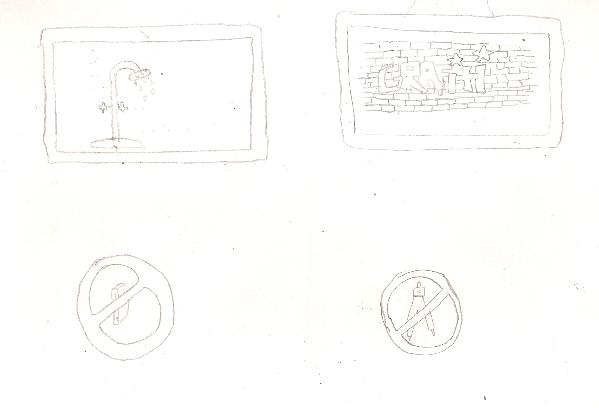
Design two signs: 
  1. one a prohibition (triangle/circle and red), 
  2. the other a permission (square/rectangle and blue)
    The designs have to be original, that means no one has created such a sign.
     Brainstorming: Students can think of things they like to do and are not allowed to, or things they hate to do and they have to do.  All the ideas will be drawn on the back of the paper and the best ones will be the final design, this time in colour.

Examples of my students' work.
Alicia M.

Joan Miquel A.

Sketches


Thursday, 26 January 2012

Signage

The main purpose of signage is communication. The signals are used to communicate in an easy way useful and important information. This are called pictograms, which take its meaning through its pictorial resemblance to a physical object.

In general, signage can be classified into the following functions:
     • Information: signs giving information about services and facilities, e.g., maps, directories, instructions  for use, etc.
     • Direction: signs leading to services, facilities, functional spaces and key areas, e.g., sign posts, directional arrows, etc.
     • Identification: signs indicating services and facilities, e.g., room names & numbers, toilet signs, number of floors, etc.
     • Safety and Regulatory: signs giving warning or safety instructions, e.g., warning signs, traffic signs, exit signs, rules & regulations, etc.


Activities______________________________________________________

1. Which shapes are mostly used? Which colours are always used?
2. Comment the signs and pictograms.
3. Work: Design two signs: one a prohibition (triangle/circle and red), the other a permission (square and blue)

Thursday, 19 January 2012

List of artistic media. Materials.

                     DRAWING                                 PAINTING
  1. Dry Media          2. Wet Media                    -Watercolour
        - Pencil              - Pen and ink                    -Tempera
        - Charcoal          - Brush and ink                -Fresco
        - Chalk                                                        -Oil paint
        - Crayon                                                      -Acrylic
        - Colour pencils                                          -Spary paint, etc
        - Marker

                PRINTMAKING                            SCULPTURE

                   - Monotype                                         - Wood
                   - Linocut                                             - Metal
                   - Woodcut                                           - Plaster
                   - Lithography, etc.                              - Wax
                                                                               - Plastic, et


Wednesday, 18 January 2012

Visual and Cultural Literacy

Questions:
•    Are the visual arts a universal language?
•    Why do you think artists create art?
•    What is art?
•    Have the humans created art since the prehistory?
•    Have they always used the same media and process a long the history?


EXPLORING ART________________________________________

The visual arts are a universal language. Through the arts, people have portrayed their world and expressed their dreams, ideas and feelings. Every work of art reflects the time and place in which it was created. For this reason, art offers us a unique opportunity to learn about our past, our history.

Why do people choose to make art? After all, we do not need art to survive, to live, as we need: food, shelter, cloths, etc. Yet, humans have created art since earliest times.

Cave of Altamira, Paleolithic

What is ART? The arts are a basic form of human communication, for example: the visual arts, music and literature. It is used to capture the interest, imagination, and appreciation of others.
  
Visual Arts. Michelangelo said, "A man paints with his brains and not with his hands." That means that you MUST have knowledge in order to create good artwork.  It is not just skill.  You must also have some sense of understanding of the basic concepts or fundamentals of art making in order to become a good artist and to enjoy art.
The problem we all live with, 1964. Norman Rockwell
India
Guernica,1937. Pablo Picasso

Choose the definition/s you like best:
   1.  Art should mirror reality. It must look like something seen in the real world.
   2.  Art must be nice (pleasing) to the eye, even if it is not realistic.
   3.  Art should express the artist’s ideas, beliefs, and feelings so that the others can understand them.

VISUAL ARTS                                                                                                                           

The visual arts are those creations we can look at, such as:

       1. Drawing                5. Printmaking* (book, poster, etc.)    
       2. Painting                 6. Photography*
       3. Sculpture               7. Video*
       4. Architecture

*Printmaking, photography and video makes us possible to create multiple copies.

Activities________________________________________

1.    Comment the images and answer the lesson’s questions.
2.    Lesson Quiz.