Showing posts with label Line. Show all posts
Tuesday, 6 October 2015
Friday, 25 September 2015
Working with... Lines I
Sunday, 1 December 2013
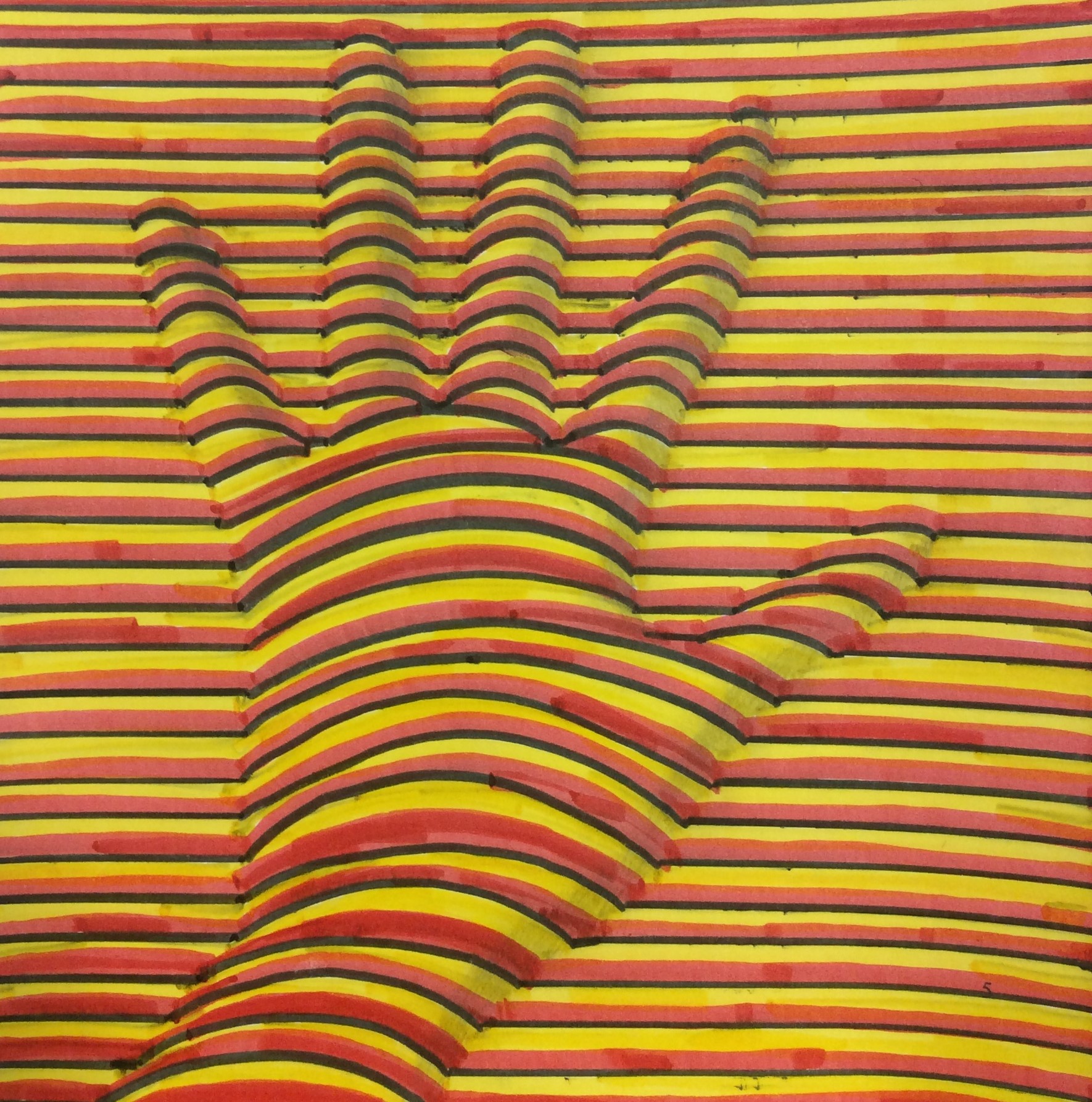
Draw a 3D hand just with lines.
![]() |
| Pablo |
If you want to have a great 3D drawing of your hand just follow the instructions:
- On a white paper trace with a pencil the silhouette of your hand.
- Choose 3 or 4 nice colours to work with. One of them has to be a dark colour.
- Draw straight lines till you get to the hand and then make a curve line till the end of the it, then keep on going with a straight line. Pretend you are drawing on top of your real hand!
Isn't it cool!!!
![]() |
| Ting |
Saturday, 21 July 2012
Working with ... lines
Wednesday, 25 January 2012
Tuesday, 24 January 2012
Line. Geometric Layouts.
GEOMETRY
Questions:
• What is geometry? is a branch of mathematics concerned with questions of shape, size, relative position of figures, and the properties of space.
• Is geometry Art or Math? Both
• What do we use geometry for? To draw and create shapes, objects, etc.
Tools:
Ruler, set of squares, compass and technical pens.
Geometric Layouts____________________________________________
Questions:
• What is geometry? is a branch of mathematics concerned with questions of shape, size, relative position of figures, and the properties of space.
• Is geometry Art or Math? Both
• What do we use geometry for? To draw and create shapes, objects, etc.
Tools:
Ruler, set of squares, compass and technical pens.
Geometric Layouts____________________________________________
- Parallel lines: Two lines in a plane that do not intersect or touch at a point are called parallel lines. Line m has everywhere the same distance to line.
- Perpendicular lines: The segment AB is perpendicular to the segment CD because the two angles it creates (indicated in orange and blue) are each 90 degrees. If a line is perpendicular to another as shown, all of the angles created by their intersection are called right angles.
- Angle bisector: An angle bisector divides the angle into two angles with equal measures. An angle only has one bisector. Each point of an angle bisector is equidistant from the sides of the angle.
- Bisection: is the division of something into two equal parts by a line, which is then called a bisector.
![]() |
If you want to check your knowledge on lines play this game: Lines
Monday, 23 January 2012
LINE
"A Line is a Dot that went for a walk" Paul Klee
Line
- is the path of a moving point: horizontal, vertical, diagonal.
- is the mark left by a tool: brush, pencil, pen, etc.
- defines the position and direction of a design, image or form.
- Types of line include vertical, horizontal, diagonal, contour or a combination of these.
- They may be curved, straight, thick, thin, smooth, long, short and so forth.
- Lines are used to create shape, pattern, texture, space, movement and optical illusion in design.
- The use of lines allows artist to demonstrate delicacy or force.
- Curves may take us slowly uphill, or turn sharply twisting our mind as they turn.
- a line can express various moods and feelings.
Look around your class. Look at the edge of objects ... you are looking at lines!.
Learn more about lines and practice drawing with them.
![]() |
| Engraving. Germany, 1568. |
![]() |
| Pablo Picasso |
Subscribe to:
Posts (Atom)